Drawdown Rules in Prop Trading — Understanding to Protect Your Challenge
Drawdown violations are the #1 reason traders fail prop challenges. Here's a complete breakdown of how daily, max, and trailing drawdown actually work.
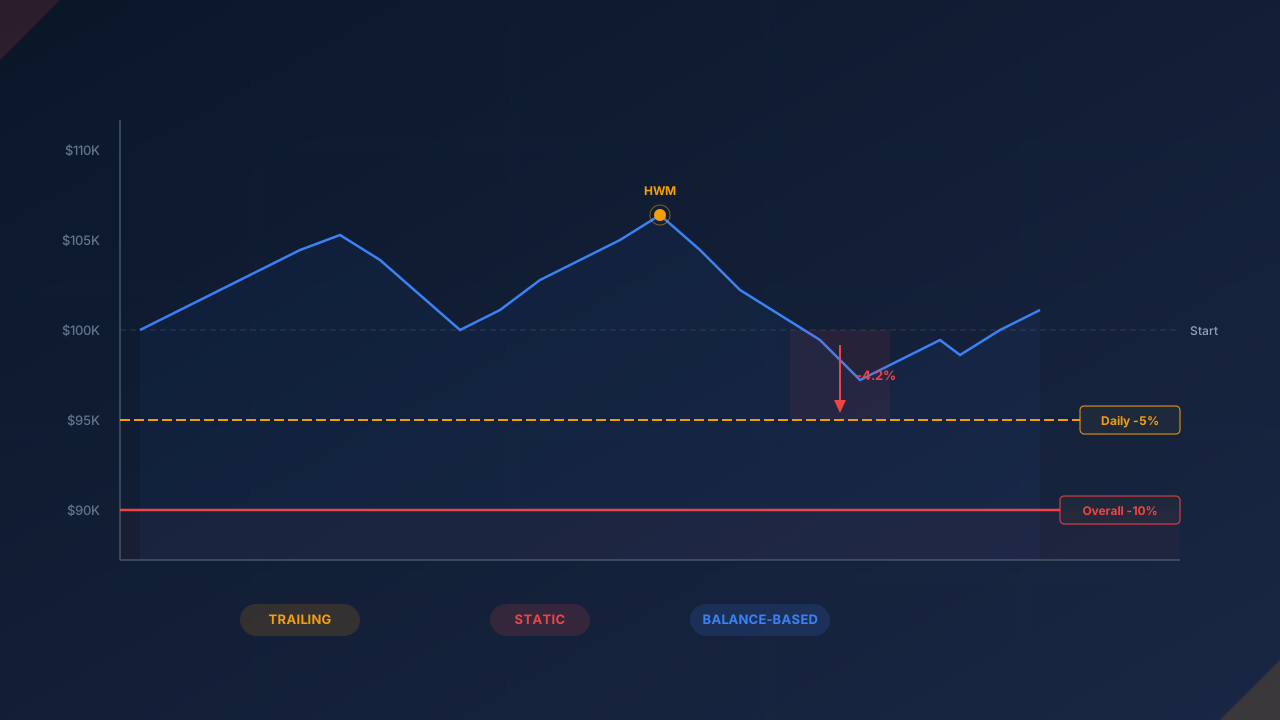
Why Drawdown Rules Matter
Most traders who fail prop challenges don't fail because they can't make money. They fail because they lose too much on a single day or cumulatively. Understanding drawdown rules isn't optional — it's the foundation of surviving in prop trading.
Daily Drawdown
Daily drawdown limits how much you can lose in a single trading day. Typically set at 4-5% of the initial account balance.
How it's calculated
Most firms calculate daily drawdown based on your balance or equity at the start of the trading day (usually server midnight or 5PM EST).
- Example: $100K account, 5% daily limit = $5,000 max daily loss
- If your balance at day start is $103,000 (from prior profits), your daily limit is still $5,000 loss from $103,000 — meaning you can't drop below $98,000 that day
- Some firms use starting balance (always $100K), others use previous day's closing balance. Read the rules carefully!
The dangerous scenario
You make +$3,000 in the morning. Your equity is now $103,000. You think "I have room to risk." But your daily drawdown limit is calculated from the higher of starting balance and highest equity reached that day at some firms. If you then lose $8,000 from your peak, you've breached — even though you still have $95,000 (above your initial $100K minus 5%).
"The most common daily drawdown mistake: making profit early in the day, then giving it all back and more. The drawdown resets daily, but your psychology doesn't."
Maximum Drawdown
Max drawdown is the total cumulative loss allowed over the entire challenge period. Typically 8-12% of the initial balance.
- Example: $100K account, 10% max drawdown = your equity can never drop below $90,000
- This is absolute: if you profit to $115,000 then drop to $89,999 → breached
- Max drawdown is your ultimate safety net — once breached, the challenge is over
Trailing Drawdown — The Tricky One
Some firms (especially Topstep, Apex) use trailing drawdown instead of or in addition to fixed max drawdown.
How it works
- The drawdown limit moves up with your highest equity but never moves down
- Example: $100K account, $6,000 trailing drawdown. Floor starts at $94,000
- You profit to $105,000 → floor moves up to $99,000
- You profit to $110,000 → floor moves up to $104,000
- If equity drops to $103,999 → breached, even though you're still $3,999 in profit from start
Why trailing drawdown is dangerous
With a fixed max drawdown, profits give you a bigger buffer. With trailing drawdown, profits actually tighten the noose. The more you make, the less room you have to give back. This fundamentally changes how you should trade.
Strategic Implications
For Daily Drawdown
- Set a personal daily loss limit at 2-3% — well below the firm's 5%
- Stop trading after 2 consecutive losses in a day
- If you're up big, consider stopping early to lock in the day's gains
- Avoid trading right after a big win (euphoria leads to overtrading)
For Max Drawdown
- Track your remaining drawdown buffer daily
- If buffer drops below 5%, reduce position size by 50%
- If buffer drops below 3%, trade only minimal positions or stop entirely
- Remember: the goal is to pass, not to maximize profit
For Trailing Drawdown
- Don't celebrate early profits — they're locking in your new floor
- Consider taking profit quickly to avoid giving back gains
- Be extra cautious after a winning streak (high watermark is now very close to equity)
- Some traders prefer to hit the target quickly and stop, rather than risk the trailing floor catching up
Common Drawdown Mistakes
- Not knowing which type: Read the firm's rules before buying. "Max drawdown" and "trailing drawdown" are completely different beasts
- Calculating from wrong base: Some firms calculate from initial balance, others from highest equity. Getting this wrong = surprise breach
- Ignoring open P&L: Drawdown includes unrealized losses (open positions). You can breach while a trade is open, even if it goes back to profit later
- Revenge trading after a loss: Down 3% → try to make it back → end up down 5% → breached
- Forgetting time zones: Daily drawdown resets at a specific time. Trading across the reset is risky