What is a Prop Firm? Business Model & Opportunities for Traders
Proprietary trading firms let you trade their capital — but how does the model actually work, and is it right for you?
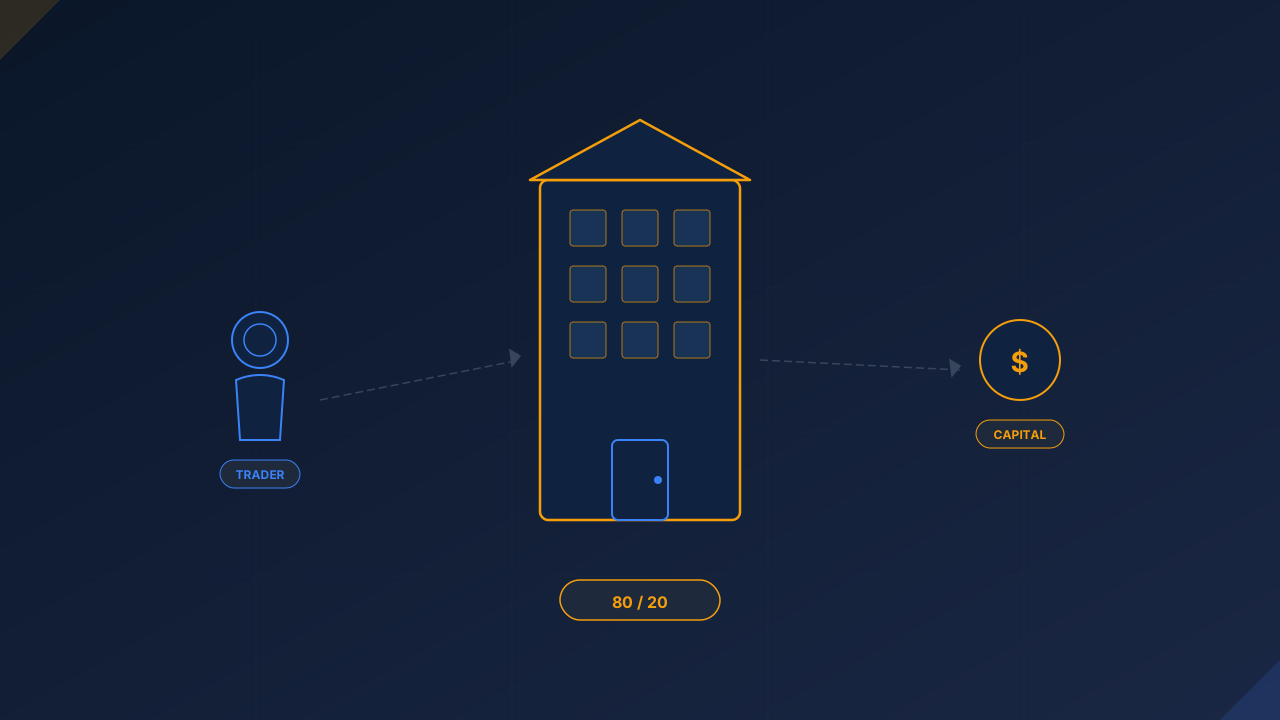
Prop Firm — The Basics
A proprietary trading firm (prop firm) is a company that provides capital to traders. Instead of risking your own money, you trade with the firm's funds and share the profits.
The modern online prop firm model works like this: you pay a fee to take a challenge (evaluation). If you pass by meeting profit targets without violating risk rules, you receive a funded account. Profits are then split — typically 70-90% to you, 10-30% to the firm.
How Prop Firms Make Money
Prop firms have two primary revenue streams:
- Challenge fees: The evaluation fee you pay upfront ($50-$1,000+ depending on account size). Since most traders fail the challenge, this is the primary income source for many firms
- Profit split: Their 10-30% share of profits from successful funded traders
This is why you should view challenge fees as a business expense, not a gamble. The firm is essentially selling you access to capital — and only if you prove you can manage it responsibly.
Traditional vs. Modern Prop Firms
Traditional Prop Firms
- Physical offices (Chicago, New York, London)
- Hire traders in-house, provide training
- Trade the firm's actual capital on real markets
- Examples: Jane Street, Optiver, DRW
- Extremely competitive entry, usually require finance degrees
Modern Online Prop Firms
- Fully remote — trade from anywhere
- Pay a fee, pass a challenge, get funded
- Most use simulated/demo accounts (your trades may not go to real markets)
- Examples: Topstep, Earn2Trade, Maverick Trading
- Open to anyone with a trading strategy — no degree required
Warning: Hybrid / Fake Prop Firms
Not all "prop firms" are real proprietary trading firms. Many online platforms are actually broker-created marketing schemes — they give traders the illusion of being "funded," but the capital is simulated, and the model is essentially a bonus/penalty system designed to collect challenge fees. Before choosing a firm, verify their regulatory status (FCA, CFTC, NFA) and whether they actually manage real trading capital.
"Modern prop firms democratized access to trading capital. You don't need $50K in savings — you need $50K in skill."
The Typical Prop Firm Process
- Choose a firm and account size: $10K, $25K, $50K, $100K, $200K
- Pay the challenge fee: Typically $80-$1,100 depending on size
- Pass the evaluation: Hit profit target (8-10%) within time limit, without violating drawdown rules
- Receive funded account: Trade the funded account following the rules
- Get paid: Request payouts (biweekly or monthly), receive 70-90% of profits
Who Should Consider Prop Trading?
- Skilled but undercapitalized traders: You have a proven strategy on demo but lack the capital to make meaningful income
- Risk-averse traders: You'd rather risk a $150 challenge fee than $10K of personal savings
- Disciplined rule-followers: Prop firms reward traders who follow risk rules consistently
- People looking for a performance-based income: No salary, no employer — just pure meritocracy
Who Should NOT Try Prop Trading (Yet)?
- Complete beginners: If you haven't been profitable on a demo for at least 3-6 months, prop trading will be an expensive lesson
- Gamblers: If you view the challenge fee as a lottery ticket, you'll lose
- Traders without a defined strategy: "I just feel the market" won't pass a challenge with strict rules
Pros and Cons Summary
Pros
- Access to large capital without personal risk
- Low barrier to entry (challenge fee vs. full capital)
- Work from anywhere, any timezone
- Keep 70-90% of profits
- Forces disciplined trading (the rules are a feature, not a bug)
Cons
- Challenge fees add up if you fail repeatedly
- Strict rules can feel limiting
- Firm risk — some firms have shut down unexpectedly
- Most accounts are simulated (not real market trading)
- Payout delays or disputes can occur with less reputable firms